
fActivism
Produced for the Welsh Water protest at Abergavenny 23.04.2022, under the Surfers Against Sewage UK-wide day of action. This is the full-text version of the print-out provided on the day.
There are many sources of river pollution. However, as the April protest is run in collaboration with Surfers Against Sewage with an aim to target water companies across the UK, this sheet of ‘factivism’ focuses on sewage and Dŵr Cymru, with extra detail on the Usk. Hopefully it will offer something you didn’t know before, help you understand the issue, and provide you with evidence that helps you voice your concern for rivers whether with friends and family or your MP.
If you are already familiar with sewage basics, skip directly to the Facts section.
Basic sewage information
Sewage is legally released into rivers where it is done under discharge consents (or registered standards in N Ireland), and is ‘generally a mixture of domestic waste water from baths, sinks, washing machines and toilets, waste water from industry and rainwater run-off from roads and other surfaced areas’ (Defra 2002). Primary treatment refers to settling out solids; secondary treatment uses bacteria that digest organic material. Only tertiary treatment removes phosphates and nitrates, the key plant nutrients behind algal blooms and changes in river plant communities. Excess nutrients and organic material are all part of the river pollution problem. Oxygen depletion, which causes fish kills, can occur either indirectly from pollution, following algal blooms (when respiration exceeds photosynthesis at night, or when algae decay), or directly, following the decay of organic matter released as sewage effluent.
The level of sewage treatment varies. Secondary treatment should be provided in areas (referred to as agglomerations) with more than 2000 (freshwater) or 10,000 (coastal) population equivalents (measured not in numbers of people but in terms of the rate of wastewater production) (UKGOV 2019a). In sensitive areas, tertiary treatment is required for discharges above 10,000 population equivalents (UKGOV 2019a, UKGOV 2019b). Sensitive areas can be declared for bathing waters, eutrophication, and/or nitrates. In Wales, sensitive areas exist along the coasts and some major catchments including the Wye (NRW 2015/2016; EEA 2022). Special restrictions can also occur on protected sites, under the Habitats Directive, where water discharges are found to negatively impact the protected features. This for example led to the implementation of phosphate stripping along the river Wye after 2009 (G Mawle, pers. comm.)
The majority of agglomerations in the UK receive secondary treatment only and fall below the EU norm (EEA 2022; 2018 data). Searching across Dŵr Cymru or other resources via Google, it seems there is no publicly available information on where in Wales secondary or tertiary treatment is undertaken, which is why we are showing data from a European site at UK and European country level (see Figure below).
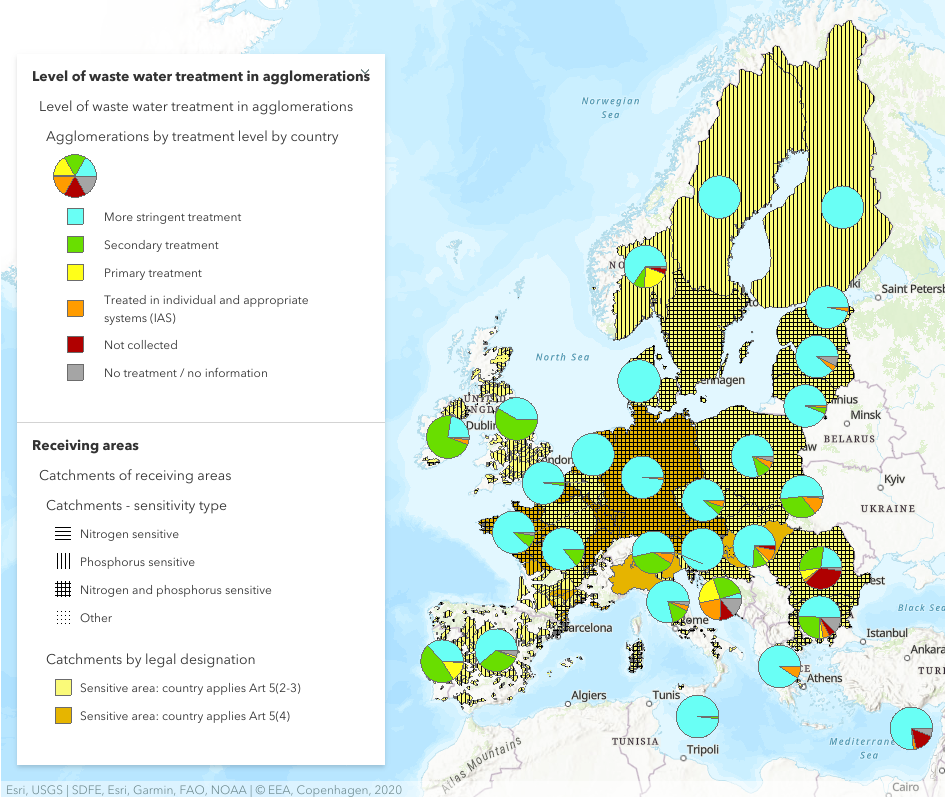
96% of the UK population is connected to sewage treatment works. The remaining 4% use private treatment works, cesspits, or septic tanks (UKGOV 2019a). They are regulated but the level of treatment achieved in practice is not controlled.
Combined sewers, and their consequent combined sewer overflows (or combined storm overflows), refer to sewers receiving both waste water, and rainwater from streets. They can legally release untreated or partially treated effluent into rivers, however this is only meant to happen in ‘exceptional’ circumstances, when for example heavy rain overwhelms the system. However, there is no easily understandable or measurable definition of ‘exceptional’ in the guidance.
Sewage outflows run under a permit system. The extent to which overflows are allowed to flow is set by the permit system. However, activists, journalists and scientists have started to discover that there are disconcertingly many unpermitted releases in registered outflows, and even completely unpermitted outflows. Event Duration Monitoring (EDM) is the relatively new system in place over the last few years which obligates water companies to report their overflow data. However, the reliability of the EDM system still requires improvement. Prior to the EDM requirement, water company regulation was performed entirely based on self-reporting by the water companies, without any EDM systems in place. (and yes, you may ask how that is possible to report reliably, or how that is possible to regulate reliably).
Facts (ordered UK-wide –> Dŵr Cymru –> Usk)
Please also see and sign our petition to Dŵr Cymru, available here.
- In terms of spring and summer algal blooms in rivers, at a UK-wide level, sewage is likely a larger problem than agriculture (agricultural sources tend to become more important in wet winter months with erosion and run-off) (Jarvie et al. 2006). This finding includes rural catchments with high risk of agricultural phosphorus loss, and the Wye was one of the study sites.
- Also at an annual rather than seasonal resolution, researchers have estimated domestic sources to be the primary source of phosphorus to rivers in Great Britain overall (White & Hammond 2009) – however this does not mean that domestic sources are the primary source for every single river in the UK.
- Investment in the maintenance of sewerage assets in England and Wales is estimated at only one sixth of the required level to keep the assets functioning (UKWIR 2017, cited in Sayers et al. 2020)
- The UK has faced European courts a number of times due to sewage release failures: for Sunderland and London in 2019 (the Independent 2019); For the Thames in 2009 (The London Economic 2021); Whitburn, and London again, in 2012 (Reuters 2012); and Burry Inlet in Wales in 2015 (BBC 2015).
- The majority of agglomerations in the UK receive secondary treatment only and fall below the European norm (EEA 2022; 2018 data). A UK Government page describes: “The UK is home to a highly successful water industry – and one that is ready to respond to global opportunities. Offering cutting-edge products and technology, as well as internationally renowned consultancy, the UK’s adaptable and innovative solutions can help to address any water-related challenge, wherever it may be in the world…. Supporting the UK water industry is a world-class regulatory framework. This has driven an efficient, innovative sector that can operate to the highest levels of environmental protection, quality maintenance and customer protection” (UKGOV 2015)
- A case study on two anonymous wastewater treatment plants in England revealed with statistical analysis that 13% of days without reported spills did in fact spill, and that spills occurred under conditions suggesting permit breach (Hammond et al. 2021)
- Sewage is of course more than just excrement. Microplastics are found wherever they are looked for, and enter through sewage outfalls as well as indirectly from farm fields where sewage sludge is applied as fertiliser (Horton et al. 2017; Thames catchment). Pharmaceuticals and other chemical products are also emerging problems. So-called forever chemicals are being found in otters across England and Wales, originating from non-stick cookware and food packaging products (BBC 2022). Some sewage treatment works are even failing the basic screening out of large objects, with wet wipes and sanitary pads filmed floating around in rivers (see e.g. here)
- Dŵr Cymru is the second-worst water company across England and Wales in terms of the occasions of (permitted) raw or partially treated sewage released into rivers, based on best estimates (water companies are not reporting consistently).
- By constituency across England and Wales, Dŵr Cymru has 5 of the top 10 worst positions based on hours of sewage released, and 7 of the top 10 worst positions based on occasions of sewage released.
- In NRW’s report on Dŵr Cymru performance in 2020 (NRW 2021), pollution incidents (based on NRW incident logs) were lowest since 2011. Water discharge permit compliance is self-reported by Dŵr Cymru and also received a Green status (NRW 2020). However, descriptive monitoring, relating to monitoring, reporting and notification of monitoring, was only 63% compliant.
- Out of 14 license compliance assessments in 2020 by NRW, 11 were in breach (NRW 2021).
- Dŵr Cymru prides itself with being a ‘not-for-profit’ company, however does pay out bonuses. In 2016 Dŵr Cymru’s chief executive was in the news for receiving bonuses of 336,688GBP on top of a basic salary of 288,261 GBP. It got missed in the Mirror’s 2022 report for the not-for-profit reason . However, the bonus structure is still used. In the accounts for 2019-2020 the Chief Executive’s base salary had increased to £318,740, and the total of bonus structures was 250,657, totalling 569,397GBP (Glas Cymru 2020)
- ‘Minor’ pollution events do not routinely get investigated by the regulator (Natural Resources Wales in Wales). These include “minor loss of fish habitat” or the death of a small number of fish from species that are not rare, the death of one or two adult salmon or sea trout, or minor human health problems. There are thousands of water pollution events recorded annually.
- The River Usk is the 7th-worst river across England and Wales in hours of sewage released. In 2020 alone it received – legally – a total of 19,952hours (or 831 days or 2.2 YEARS) worth of raw or partially treated sewage (top of the poops), on top of the regular sewage effluent, and on top of unknown and known illegal releases (see e.g. here and the BBC Panorama episode).
- The Usk is a Special Area of Conservation, yet does not lie in a ‘sensitive area’ and has not been flagged as being threatened by sewage under the Habitats Directive, and therefore there are no requirements for tertiary sewage treatment. To our knowledge there are only two treatment sites with tertiary treatment along the river (G Mawle, pers. comm.). You can see officially recorded treated and untreated release estimates on the Rivers Trust sewage map (RT 2021)
- The Usk is the worst SAC in Wales for excessive phosphate with 88% of its water bodies failing water quality targets (Mawle 2021). Mawle writes:
Despite being a Special Area of Conservation, the future of the river Usk and its ecology looks bleak. Other than salmon, the designated features are not being well monitored, let alone being ‘maintained and restored’. If the decline of the Usk, and Wales’ other rural rivers, is to be halted and reversed, radical and urgent changes are required. ‘Business as usual’ means further deterioration due to climate change, poor agricultural practice, and inadequate sewage treatment. It is hoped that this failure will be recognised by the Future Generations Commissioner and Audit Wales.
References
BBC 2015. By Iolo ap Dafydd. 12th November. Burry Inlet sewage European court case looms. (last accessed 27.03.2022)
BBC 2022. By Claire Marshall. 25th January. (last accessed 27.03.2022)
CCRA3 [Climate Change Risk Assessment] 2021. By Netherwood A. Evidence for the third UK Climate Change Risk Assessment (CCRA3) Summary for Wales.
CEH [Centre for Ecology and Hydrology] 2022. Enhanced Future Flows and Groundwater (eFLaG) Portal.
Dallison et al. 2021. Impacts of climate change on future water availability for hydropower and public water supply in Wales, UK. Journal of Hydrology: Regional Studies 36:100866.
Defra 2002. Sewage Treatment in the UK – UK Implementation of the EC Urban Waste Water Treatment Directive
EEA [European Environment Agency] 2022. Urban wastewater treatment map (last accessed 26.03.2022); see also here for trends
Glas Cymru 2020. Glas Cymru – Annual report and accounts 2019-2020.
Hammond P et al. 2021 Detection of untreated sewage discharges to watercourses using machine learning. npj Clean Water 4:18
Horton et al. 2017 Large microplastic particles in sediments of tributaries of the River Thames, UK – Abundance, sources and methods for effective quantification. Marine Pollution Bulletin 114: 218-226.
Jarvie et al. 2006 Sewage-effluent phosphorus: A greater risk to river eutrophication than agricultural phosphorus? Science of the Total Environment 360: 246 – 253.
Mawle G 2020. A dying river? The state of the river Usk. Available here together with accompanying communications with the Welsh Minister for Climate Change, and the Chair for the NRW Board.
NRW 2015/2016. Lle geo-portal: Sensitive areas – Bathing Waters, Eutrophic, and Nitrates.
NRW 2021. Annual environmental performance report for Dŵr Cymru Welsh Water 2020. Available here
Reuters 2012. By Ethan Bilby. 18th October. Top EU court finds Britain guilty of dumping raw sewage. (last accessed 27.03.2022)
RT [Rivers Trust] 2021. Is my river fit to play in? – interactive map available here
Sayers et al. 2020. Third UK Climate Change Risk Assessment (CCRA3): Future flood risk. Research undertaken by Sayers and Partners for the Committee on Climate Change. Published by Committee on Climate Change, London.
The Independent 2019. By Josh Gabbatiss, 3rd Feb 2019. UK facing European court after government fails to stop sewage spills. (last accessed 27.03.2022)
The London Economic 2021. By Jack Peat 25th October. Flashback: To when the UK govt was taken to European Court of Justice for breaking sewage rules . (last accessed 27.03.2022)
UKGOV 2015. Promotional material: Water and treated water (last accessed 27.03.2022)
UKGOV 2019. Guidance: Waste water treatment works: treatment monitoring and compliance limits. Available here (last accessed 26.03.2022)
UKGOV 2019b. Policy paper: Urban waste water treatment: updated sensitive areas maps 2019. Available for England here (last accessed 26.03.2022)
UKWIR (2017). Long term investment in Water and Sewerage networks. February. UK Water Industry Research Ltd., London. 7/RG/05/47
White & Hammond 2009. The sources of phosphorus in the waters of Great Britain. J. Environ. Qual. 38:13–26 .